How to Become a Solar Installer in the UK: Electrician First, MCS Second — and the £50k+ Triple-Skill Ceiling
Solar installation is where the UK's electrical trade meets its growth market — and the career question arrives with a common misconception: there is no standalone "solar installer" ticket worth having. The trade is built on electrician qualifications, with solar as the specialisation on top — and the MCS badge as the commercial key. Here's the honest 2026 route.
In short: The path is electrician first: a Level 3 electrical qualification (2365 Diploma or equivalent) plus the 18th Edition — then the City & Guilds 2922 Solar Photovoltaic qualification on top. From scratch: two to three years. Employed PV electricians earn £35,000–£50,000 (range £32,000–£52,000); multi-skilled installers (PV + battery + EV charging) reach £45,000–£60,000 employed and £50,000–£75,000+ self-employed.
The qualification stack
| Layer | What it is |
|---|---|
| Level 3 electrical (2365 Diploma or equivalent) | The foundation — solar is electrical work at height |
| 18th Edition (BS 7671) | The wiring regulations certificate every working spark holds |
| City & Guilds 2922 Solar PV | The solar specialisation — requires the two above first |
| Working at height (PASMA/IPAF) | The roofline reality of the job |
| EESS battery storage | The add-on that moves you up a pay band |
The MCS question — employed vs own-badge
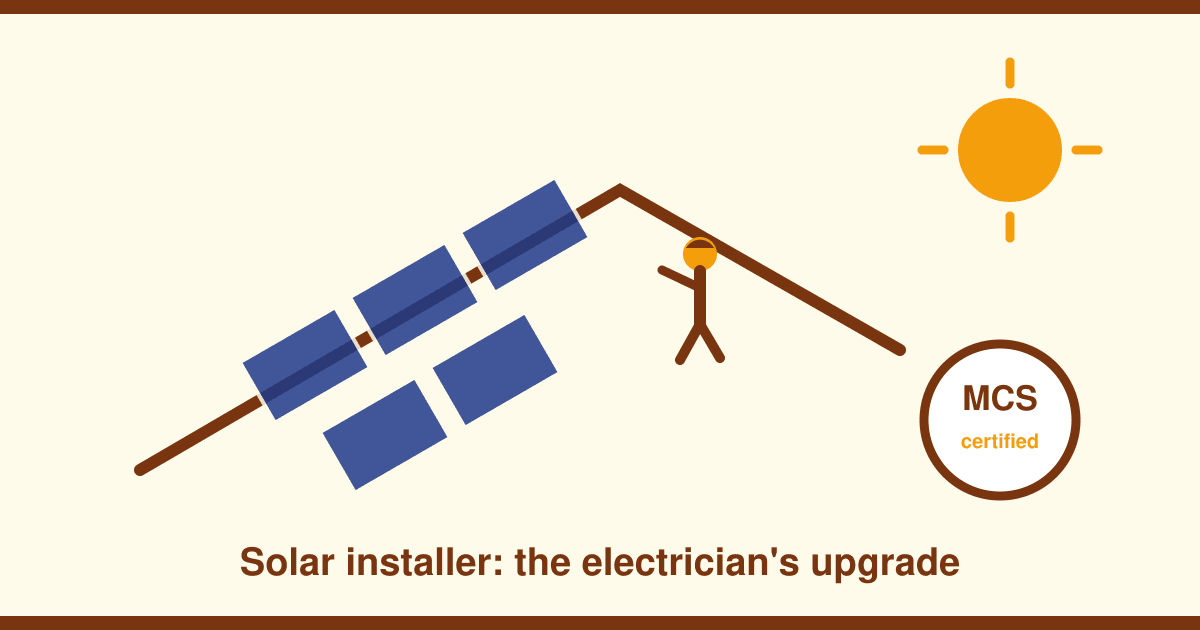
MCS certification is the commercial heart of domestic solar: without it, customers can't register for Smart Export Guarantee payments, and most won't consider the installer — it's the accreditation customers are told to demand. Two ways to work under it:
- Employed route: join an MCS-certified firm as a qualified electrician — the company's certification covers your installs, immediate market access, zero certification admin. The standard first move.
- Own-badge route: for the self-employed — Competent Person Scheme membership (NICEIC/NAPIT) first, then a separate MCS application at £500–£1,500 initial plus £300–£500 a year in surveillance and renewal. Worth it once you have pipeline; premature before.
The pay ladder — and the triple-skill logic
- PV-only electricians: £35,000–£45,000 employed.
- PV electricians generally: £35,000–£50,000 (full range £32,000–£52,000 by region and competence).
- Multi-skilled (PV + battery storage + EV charging): £45,000–£60,000 employed — the market pays for the installer who completes the whole home-energy package in one visit, EV charger included.
- Self-employed triple-skill: £50,000–£75,000+ — the current ceiling of the domestic renewables trade.
The strategy writes itself: every additional string (battery EESS, EV charging) compounds, because customers increasingly buy the bundle — and the installer who quotes it all keeps the whole margin.
Getting started, practically
Existing electricians are weeks away — the 2922 course plus height tickets and a battery qualification, then an MCS employer or the own-badge maths. Newcomers should treat this as the electrician's route with a destination: apprenticeship or adult-learner route to Level 3, choosing solar-active employers early so the specialisation grows alongside the fundamentals. And for career changers from roofing or construction: solar teams also need competent roof-side installers working alongside the electricians — a legitimate entry that pairs naturally with later electrical study.
Market honesty: solar demand tracks policy and energy prices, and both currently point one way — but the trade's insurance is that the underlying qualification is electrician: if solar ever slows, the Level 3 and 18th Edition remain the most portable tickets in construction. The specialisation is upside; the foundation is the safety net.
The bottom line
Electrician first (two to three years from scratch), the 2922 solar qualification and height tickets on top, MCS via an employer until your own pipeline justifies the £500–£1,500 badge — then stack battery and EV skills toward the £50,000–£75,000 triple-skill ceiling. For homeowners on the hiring side: find MCS-certified solar installers near you here.
Frequently asked questions
A Level 3 electrical qualification (such as the 2365 Diploma) and the 18th Edition wiring regulations first, then the City & Guilds 2922 Solar Photovoltaic qualification, plus working-at-height certification. Solar is a specialisation on top of the electrical trade, not a standalone ticket.
From scratch, two to three years — roughly two years of electrician training plus the solar qualification. Qualified electricians can add the 2922 solar course, height tickets and battery qualifications within weeks.
MCS is the accreditation domestic solar runs on — without it customers cannot register for Smart Export Guarantee payments. Employed installers are covered by their firm’s MCS; the self-employed need Competent Person Scheme membership plus their own MCS application (£500–£1,500 initial, £300–£500 a year ongoing).
Employed PV electricians earn £35,000–£50,000 (range £32,000–£52,000). Multi-skilled installers covering PV, battery storage and EV charging reach £45,000–£60,000 employed, and self-employed triple-skill installers earn £50,000–£75,000+ — the current ceiling of the domestic renewables trade.